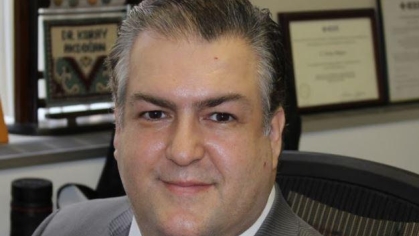
CEE Professor Awarded Federal Grants Supporting Infrastructure Resilience
Hao Wang, a professor and graduate program director in the Department of Civil and Environmental Engineering, recently received awards from the U.S. Department of Transportation Pipeline and Hazardous Materials and Safety Administration (PHMSA) and the Federal Aviation Administration (FAA) to support projects addressing critical challenges of national energy and transportation infrastructure.
According to Wang, it is especially rewarding to see his work supported by federal agencies and to be able to contribute research with the potential to improve infrastructure resilience and public safety.

Additionally, he says, "the awards allow my research team to advance cutting-edge technologies at the intersection of engineering, sensing, and AI."
Faster, Safer, Cost-Effective Pipeline Monitoring
The three-year, $1.1 million PHMSA award funds the development of innovative electromagnetic methods for detecting and locating oil pipeline leakage. Led by PI Wang, it is supported by researchers at Texas A&M University and the University of Dayton.
"When oil leaks from a buried steel pipeline, it changes the integrity of the pipeline and the electromagnetic properties of the surrounding soil," Wang explains. Using hybrid sensing technologies, such as ground penetrating radar and electromagnetic reflectometry, Wang's team will analyze measured signals with advanced data processing and AI algorithms to identify and pinpoint the presence and location of a pipeline leak before it becomes a greater environmental or safety hazard.
"This approach," he adds, "enables earlier rapid screening of long pipeline segments to help operators prioritize areas for detailed inspection or maintenance, while reducing environmental damage, preventing product loss, and lowering inspection costs for pipeline operators."
According to Wang, his newly developed technologies will offer commercialization potential improved methods for monitoring pipeline integrity that can be integrated into existing inspection workflows and eventually transition to industry through partnerships and technology transfer.
Improving Airport Infrastructure Durability and Safety
Wang's $600,000 FAA grant supports three years of research aiming to advance airport pavement design through predictive modeling of reflective cracking using experimental data, numerical simulations, and artificial intelligence. His project team includes Department of Materials Science and Engineering Associate Professor Ryan Sills.

Wang explains that "reflective cracks move upward through new asphalt overlays. On airport runways, by reducing pavement durability, these cracks demand more maintenance and increase safety risks from foreign object debris."
His project proposes developing a physics-informed AI model that weds neural network to established engineering and physics principles. "Rather than relying on data or physics alone, it also incorporates the physical laws governing material fracture behavior, resulting in more accurate and reliable predictions of reflective cracking," he reports.
By focusing on how reflective cracks initiate and grow under cold environments and aircraft load, Wang's research can lead to longer-lasting runways by transforming airport pavement design and supporting more proactive maintenance planning. Ultimately, infrastructure costs would be reduced, and airport runway safety would be improved.